
Carnivores We Study
The Wolverine
The wolverine is known for its tenacious ability to travel hundreds of miles across all kinds of terrain. In the Pacific Northwest, it tends to live around treeline and depends on small and medium-sized mammals, and carrion for food. Denning sites are typically located on N and NE-facing slopes where snow persists into late spring (e.g. May). In 2006, a wolverine was photographed on Mount Adams by biologists with the Yakama Nation, marking the first modern record of wolverines in the area since 1920. Our biologists and community scientists have been monitoring wolverines in the South Cascades since 2006 through non-invasive DNA samples and remote camera stations.
Current StudY
Return Of The Wolverine To Washington’s South Cascades: We have been working alongside the USFS and WDFW for over a decade to monitor and study the recovery of the wolverine to the Cascade Range. Current needs are to gather and analyze data, determine where wolverines are reproducing and which portions of their distribution are most important to protect, and understand the trend of their population.
In The News
The Oregonian | It’s Triplets for this Incredibly Rare Mammal
National Wildlife Magazine | A Wolverine Ode To Joy
Courier Herald | Joni the Wolverine Does it Again
Columbia Insight | Wolverines Win in Latest Court Decision
Smithsonian Magazine | First Wolverine Family Makes a Home
Columbia Insight | Baby Comeback: Wolverine Triplets
CNN | For The First Time In More Than 100 Years, The Extremely Rare Wolverine Has Returned To Mount Rainier National Park
Courier Herald | For Mount Rainier’s Wolverine, It’s Paradise
USA Today | Wolverines spotted at Mount Rainier National Park for the first time in over 100 years
Seattle Times | Wolverines return to Mount Rainier National Park after 100 years
KOMO News | Wolverines Return To Mt Rainier For First Time
Columbia Insight | Wolverines Break Through ... Finally!
Oregon Public Broadcasting | Where Have All The Wolverines Gone? Apparently Not On The Endangered Species List
King 5 News | Inside The Lone Known Wolverine Den
Oregon Public Broadcasting | 1st Wolverine Mother Found In Washington’s South Cascades
Seattle Times | Wolverine Babies Heading South, And Researchers Love It.
Seattle Times | Wolverines Claw Their Way Back: Breeding ‘Gluttonous Glutton’ Found In Washington’s South Cascades
Yakima Herald-Republic | Breeding Wolverine Found in Naches Ranger District, Heralds Comeback in Cascades
Seattle Times | Wolverine Caught on Camera on Mount Adams
The Cascade red fox
The Cascade red fox is a subspecies of red fox uniquely adapted to survive harsh winters in the Cascades mountains. It generally lives above 4,500 ft in elevation and depends upon small prey, as well as berries and insects in the summer. It is one of the rarest carnivores in the Pacific Northwest, with only 16 known, genetically distinct families (Akins, 2018). During over a decade of survey effort, our research identified areas of occurrence throughout the South Cascades including Mount Adams, Mount Rainier, the Indian Heaven, Goat Rocks, William O. Douglas. and Norse Peak Wilderness, and Ahtanum State Forest. We estimated occupancy to be 30% in the South Cascades (Akins 2017). Cascades Carnivore biologists and community scientists have been monitoring the fox since 2008 through non-invasive DNA sampling and remote camera stations.
In The News
Smithsonian Magazine | The Fox Family of Mount Rainier
Smithsonian Magazine | Where Fox News is Hard to Come By
National Wildlife Magazine | Cascade Red Fox Cascading Effects On Survival
Seattle Times | WA Lists the Cascade Red Fox as Endangered
Columbia Insight | Enviros Await Decision on Cascade Red Fox
Seattle Times | WA Considers Listing Cascade Red Fox
Publications
Lewis et al. 2022 | WDFW Periodic Status Report of the Cascade Red Fox
Akins et al. 2018 | Genetic integrity, diversity, and population structure of the Cascade red fox
Akins 2017, PhD Dissertation | Distribution, Genetic Structure, and Conservation Status of the Cascade Red Fox in Southern Washington
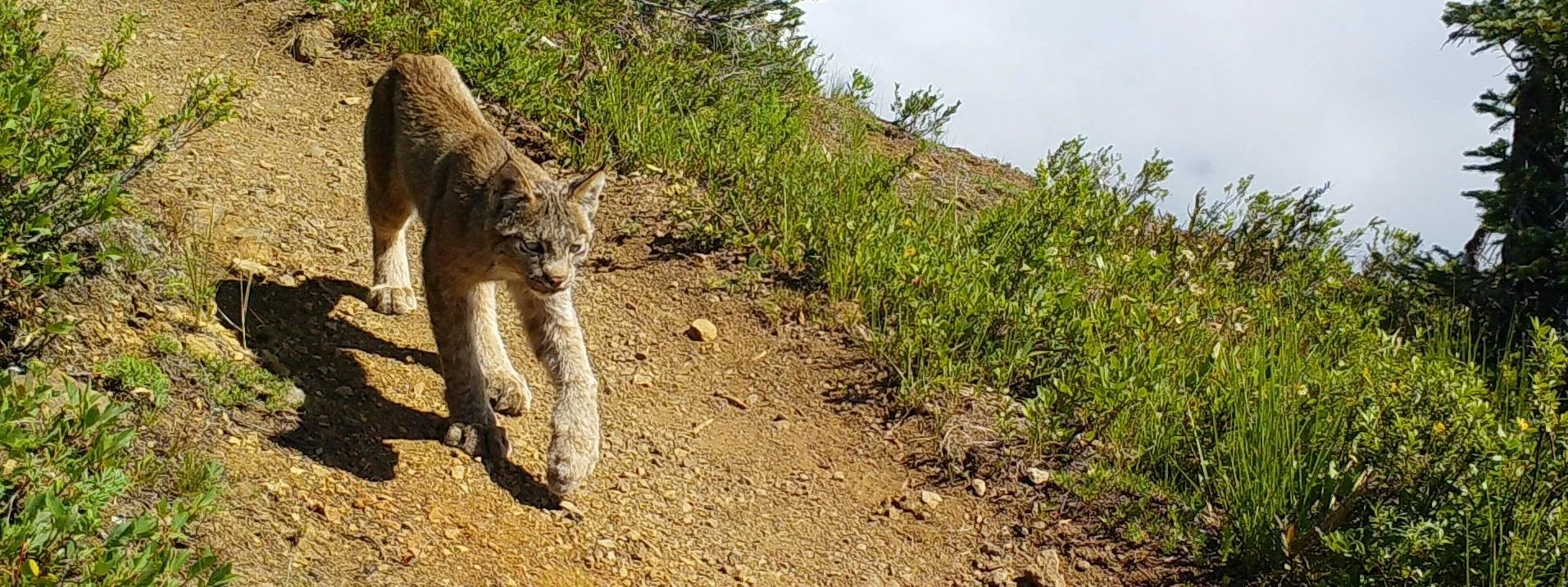
The Canada Lynx
Current Research
Canada Lynx Genetics and Connectivity in Washington’s North Cascades and British Columbia: Turning six years of DNA samples into a rigorous scientific paper is slow, careful work, and we are close. When it is published, it will be the first genetic picture of Washington's remaining lynx population.
In The News

Photo of the Goat Rocks Wilderness by Jocelyn Akins