• Team
    • Board of Directors
    • Advisors
    • Alumni
    • Films
    • Events
    • Newsletter
    • Volunteer
    • Contact Us
  • Blog
  • In the News
    • Give Once
    • Give Monthly
    • CCP Gear
    • Matching Gift
  • Donate
Menu

Cascades Carnivore Project

Street Address
City, State, Zip
Phone Number
Our Mission: To study and restore Washington Cascades wolverine, cascade red fox, Canada lynx, and other threatened carnivore populations at risk of extinction and the mountain ecosystems they call home.

Your Custom Text Here

Cascades Carnivore Project

  • About Us
    • Team
    • Board of Directors
    • Advisors
    • Alumni
    • Films
  • Join Us
    • Events
    • Newsletter
    • Volunteer
    • Contact Us
  • Blog
  • In the News
  • Support Us
    • Give Once
    • Give Monthly
    • CCP Gear
    • Matching Gift
  • Donate

THE SNOWPACK AND WHAT IT MEANS FOR WOLVERINES

February 11, 2026 Gretchen Stuart

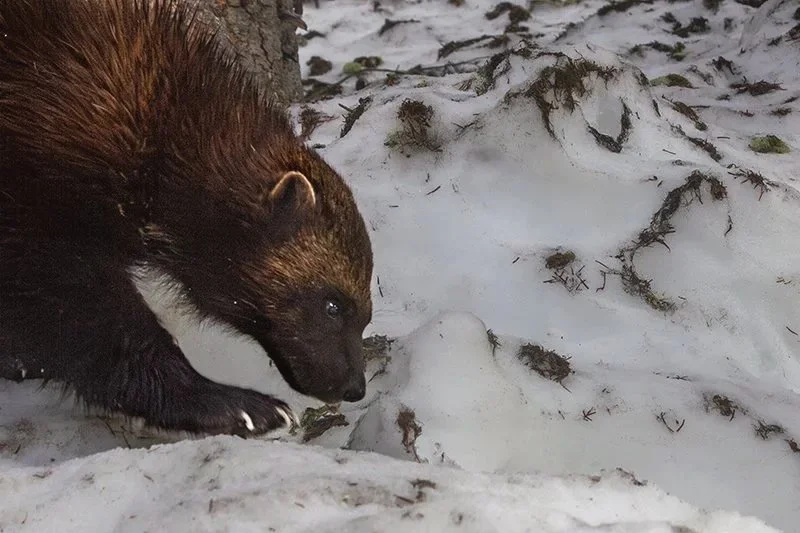
DSLR camera trap photo of Van, the male reproducing wolverine in our study area.

Words and Photos by Gretchen Kay Stuart

As the changing climate continues to warm our planet, those affected will reach far beyond disappointed skiers in Washington’s Cascades this winter. According to the latest data from the U.S. Department of Agriculture, Washington’s snowpack currently holds just 52% of its normal water volume, with little relief on the horizon.

We often discuss snow in terms of what it means for us: reservoirs, irrigation, and the increased wildfire risk that comes along with drought. For wolverines, this shift poses challenges as well. Deep snowpack is important for reproduction and kit survival.
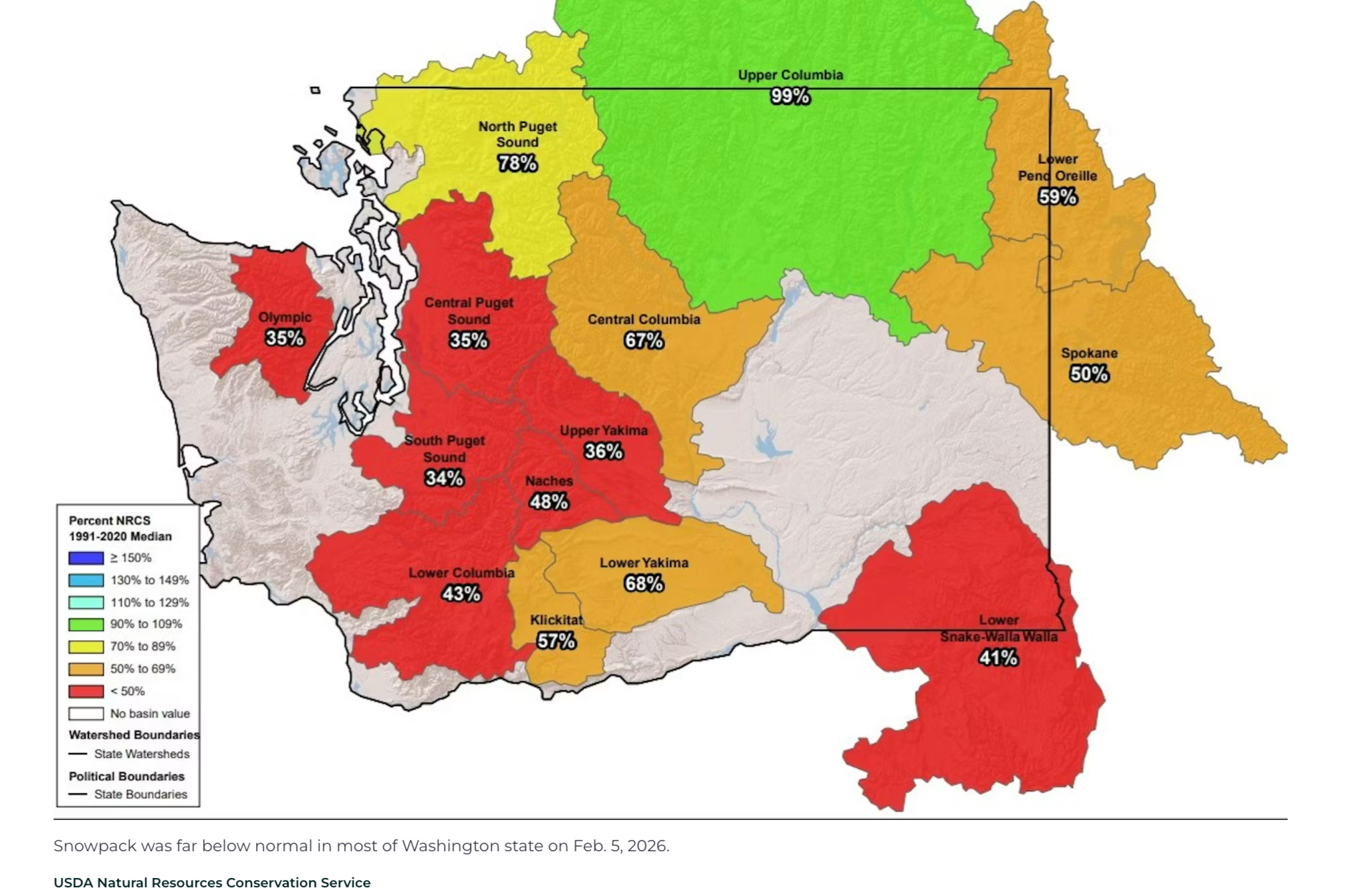
Wolverine habitat in our study area has only received 34% of its annual snowpack as of February 5, 2026.

Around this time of year, wolverines give birth in dens carved not into soil, but into deep snow that persists until late spring when their kits are strong enough to start traveling with their mothers. These are not simple holes. They are intricate chambers dug into drifts that provide stable insulation against surface temperatures. The subnivean (under-snow) environment maintains a constant temperature near freezing, regardless of whether the air above is 0°F or 40°F. For wolverine kits, that stability is the difference between life and death.

Warm conditions in the Cascades create rain-on-snow events. When warm rain trickles through the snowpack, it adds weight and destroys the insulating properties of deep, fluffy snow. Wet snow can also collapse the subnivean world entirely, which wolverines and other carnivores rely upon for some of their prey.

Wolverine mothers also must plan ahead and find food for themselves and their kits when they are young and unable to leave the den. They sustain themselves in part on caches of meat stored in the snow, for example, in tree wells, which act as refrigerators to preserve their food for longer periods of time. They will stock these refrigerators in early winter before kits are born. If the refrigerator fails, the meat can thaw and rot, forcing wolverine mothers to find food elsewhere.
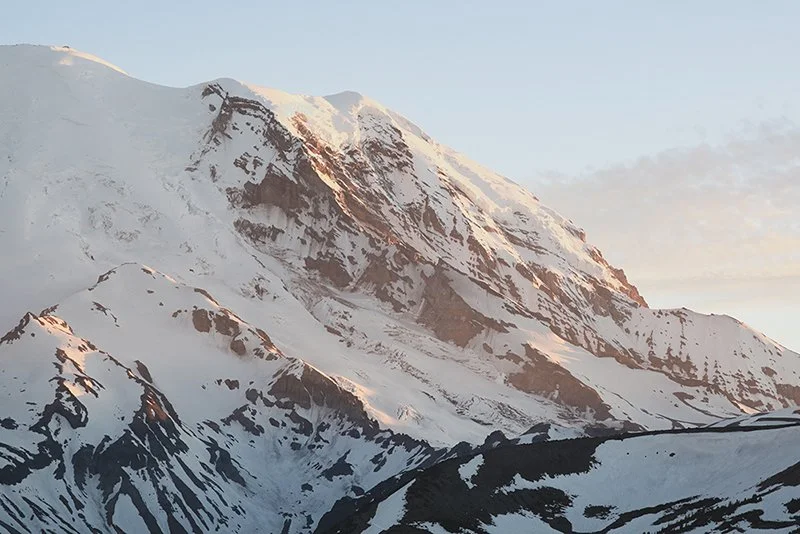
Mount Rainier by Gretchen Kay Stuart

Wolverine habitat in the Washington Cascades alpine.

Despite these challenges, there is hope. The female wolverine in our study area has consistently reproduced with success. At least one of those offspring dispersed to Oregon and perhaps traveled further to the Sierra Nevadas where a wolverine was recently detected.

What can we do? There are many small changes to diet and lifestyle that can add up to great impact. But most importantly, we can vote in local elections. Ask that our state representatives prioritize climate change and protection of our public lands and the Endangered Species Act. Educate friends and family about the importance of biodiversity, and encourage them to vote, too. With effort and time, we just might succeed in turning things around not only for the wolverine, but for all life on earth.
In wolverine, gulo Tags carnivore conservation, Mount Rainier National Park, gulo gulo, wolverine, climate change

GRETCHEN'S DEN DISCOVERIES (Post #3)

January 21, 2026 Gretchen Stuart

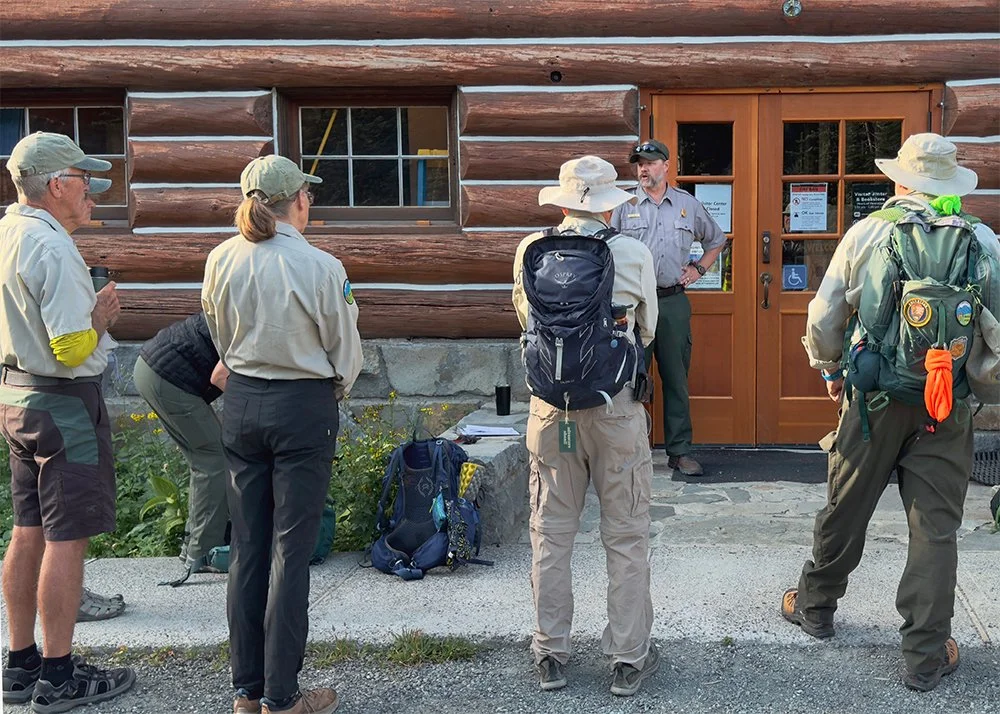
Volunteer Meadow Rovers meet with Ranger, David Divelbiss, for a morning briefing.

Words and Photos by Gretchen Kay Stuart

Let’s hear it for the Meadow Rovers!

Last year, I had special access to conduct daily observations of endangered Cascade red fox kit rearing at the first successful den site found within Mount Rainier's park boundaries since 2017.

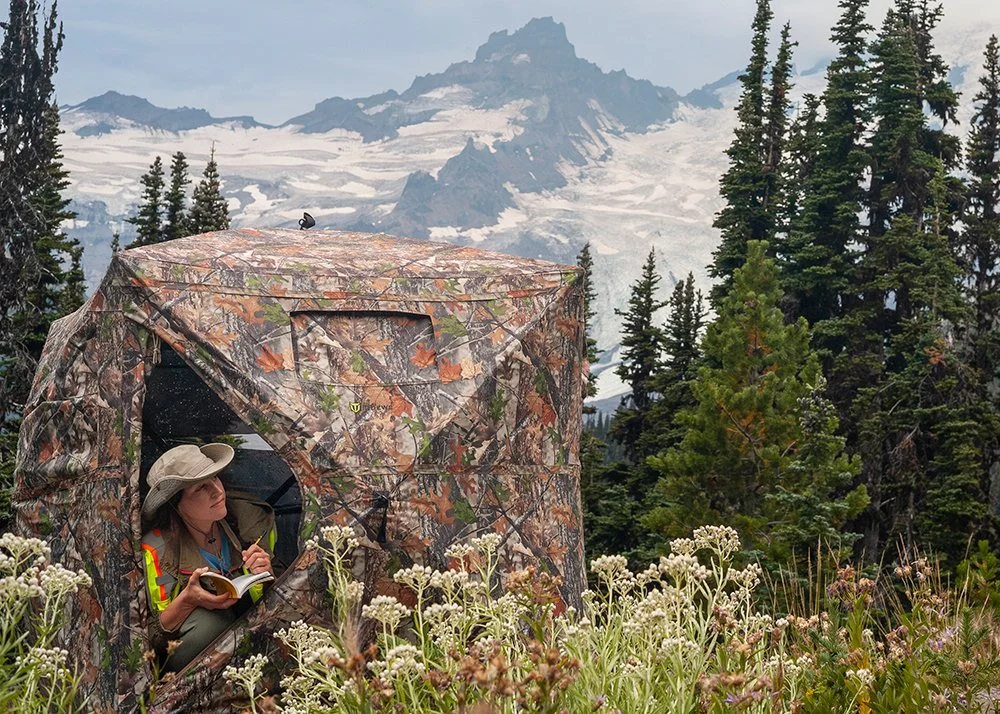
Gretchen observes endangered Cascade red fox kits from a blind, recording detailed field notes.

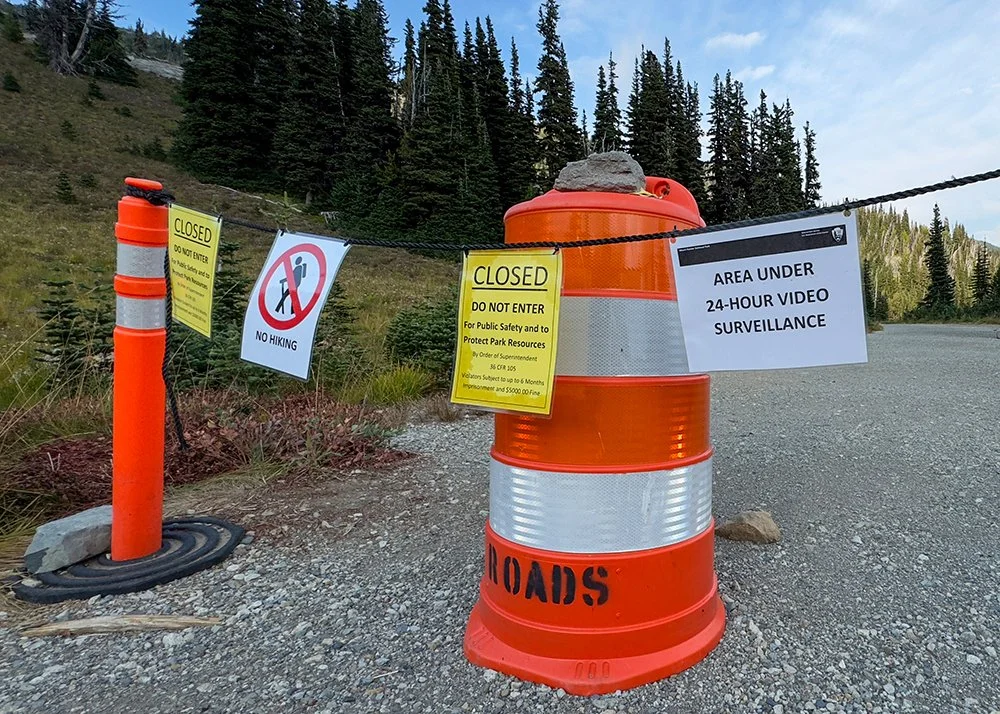
Following the identification of the den site, the park’s Resource Manager, Sallie Beavers, and Superintendent, Greg Dudgeon, swiftly implemented trail closures to mitigate risks of human habituation and food-conditioning. Violators risked up to 6 months jail time and a $5,000 fine.

This management action was reinforced by Ranger David Divelbiss and his phenomenal team of volunteer Meadow Rovers who stood guard day and night at every closed trailhead to ensure the orders were respected.

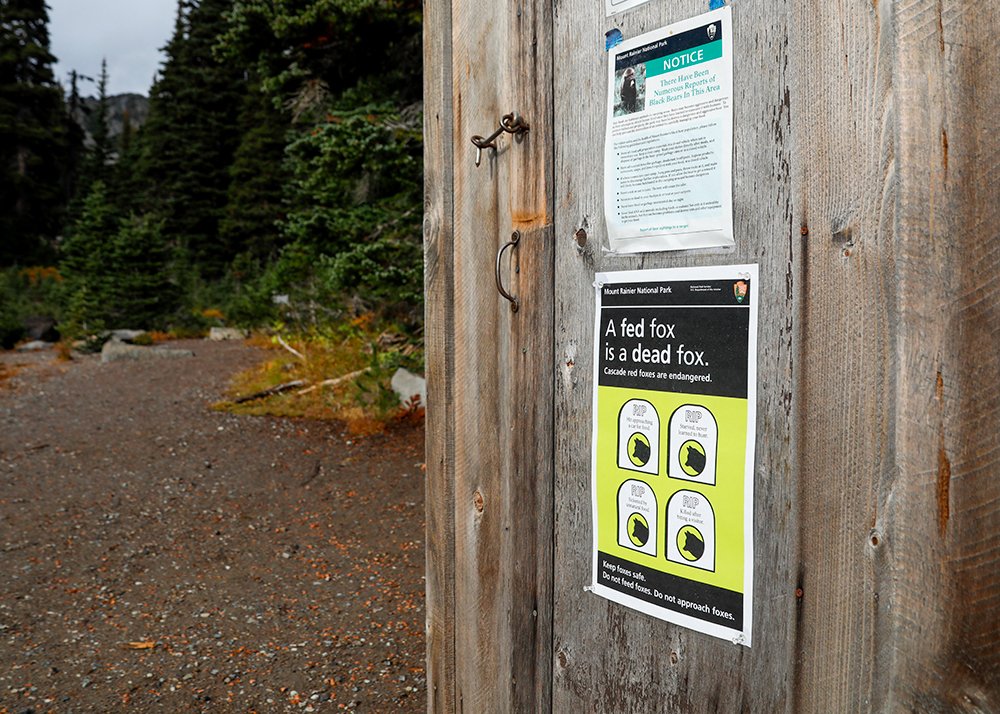
Fed Fox is a Dead Fox Gretchen Kay Stuart 2.JPG
Cascade red fox research Gretchen Kay Stuart 2.jpg

One of the greatest threats faced by the Cascade red fox is car strike fatalities due to food-conditioning. Foxes that are fed even once by visitors start viewing humans as easy meal tickets. Eventually, they are lured to roads where encounters are more frequent, and the foxes are often struck and killed.

I believe it is because of the incredible effort by NPS staff and volunteers that all three kits survived and matured into thriving juveniles. By winter, they dispersed into the Cascades wilderness to establish territories and find mates, pushing their unique subspecies a meaningful step back from the brink of extinction.

This success stands in stark contrast to the tragic loss of a separate litter to rodenticide poisoning at a nearby ski resort. It underscores just how vital our National Parks are for the survival of endangered species, and reaffirms the importance of keeping our public lands funded and protected.

A heartfelt thank you to the dedicated NPS staff and Meadow Rovers who made this conservation achievement possible!

In Cascade red fox, community science Tags Cascade red fox, carnivore conservation, Community Science, Mount Rainier National Park, Meadow Rovers

GRETCHEN'S DEN DISCOVERIES (Post #1)

November 19, 2025 Gretchen Stuart
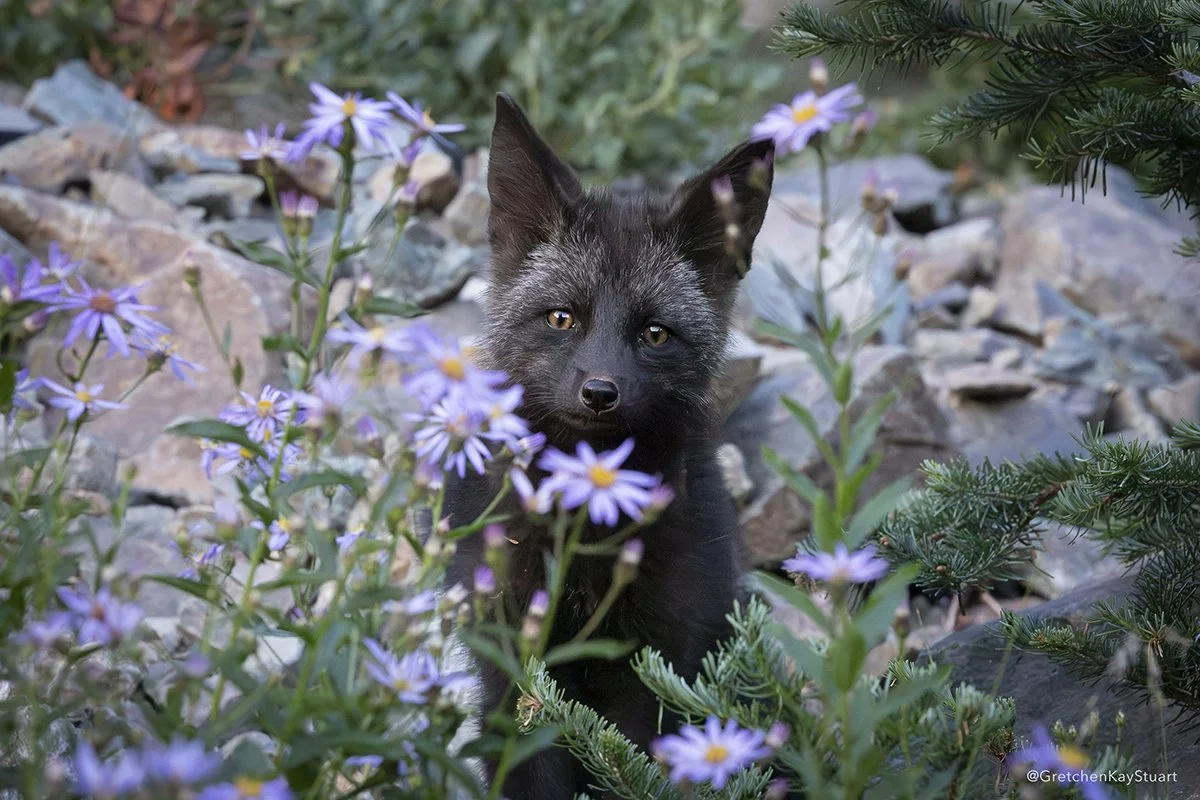
Cascade red fox kit by Gretchen Kay Stuart

“Loner”

Words and Photos By Gretchen Kay Stuart

Last June, a routine patrol by a Meadow Rover, (a volunteer who educates visitors about the fragile wildflower meadows at Mount Rainier National Park), resulted in the discovery of three Cascade red fox kits. At approximately two months old, these vulnerable pups belonged to the first active den found within park boundaries since 2017. To shield them from the dangers of human crowds and food-conditioning, the National Park Service took immediate action, establishing a protective closure around the den site.

In my sixth year of field efforts dedicated to studying this elusive subspecies, this was a dream scenario. As part of a science team, I had access to monitor the den site, allowing me to conduct daily in-depth observations of Cascade red fox kit rearing. While I am saving the most exciting findings for future posts, today, I would like to introduce you to the three adorable kits at the heart of this story.

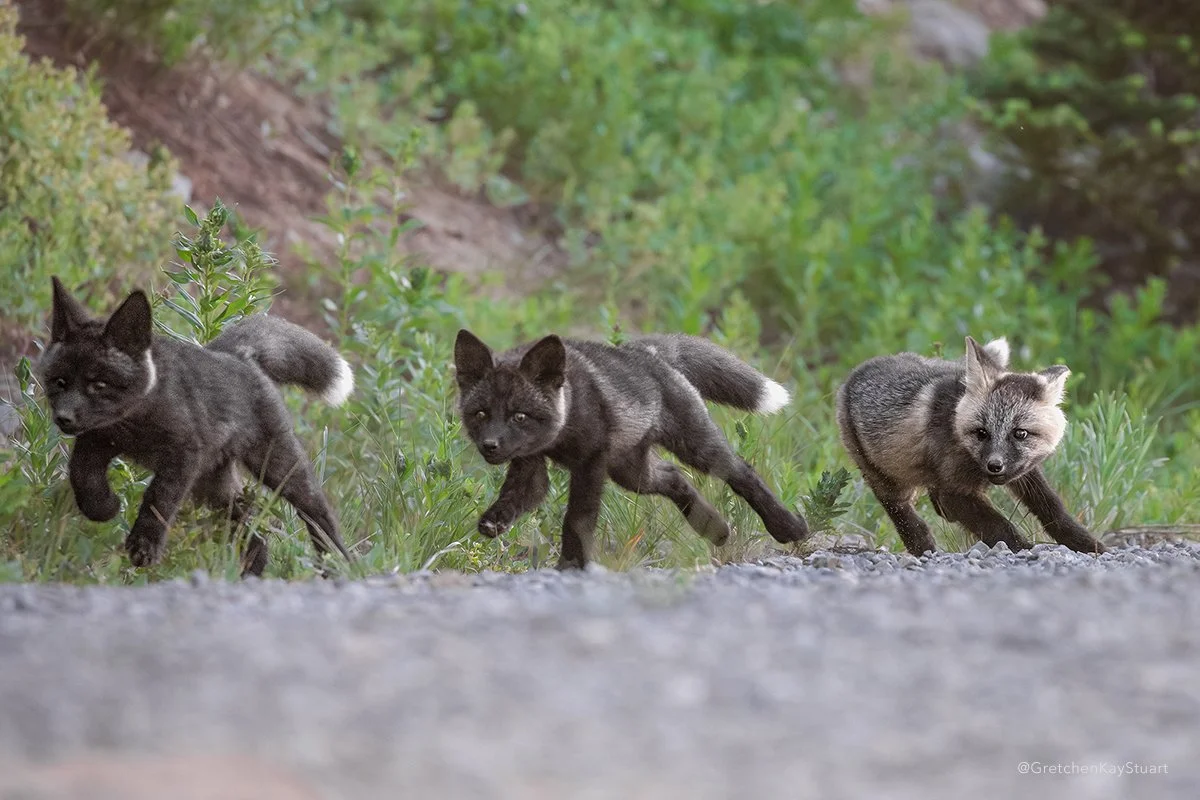
Cascade red fox kits by Gretchen Kay Stuart

Left to right: 2B, Loner, Sunny

The Cross-Phase Male: In my field notes, I initially called this distinctive kit “Cross.” But during a Q&A I held with park Rangers, the perfect name was suggested: Sunny. It suited him wonderfully, and the name stuck.

The Two Black-Phase Sisters:  We believe two kits are females due to the ability to zoom in on high resolution photos.

One sister has slightly lighter markings on her belly. I gave her the temporary name "Loner" because I often found her at a separate den entrance from her siblings—perhaps a clever strategy to spread the risk if a predator were to discover them.

The other sister, whom I logged as "2B" (for 2nd black kit), was the bold explorer of the family. Her insatiable curiosity quickly won me over and I developed a special fondness for her emerging personality.

Official naming of the sisters is still to come. I hope the honor will go to the incredible team of Meadow Rovers who diligently stood guard at trailheads for this fox family over the most sensitive months of their development.

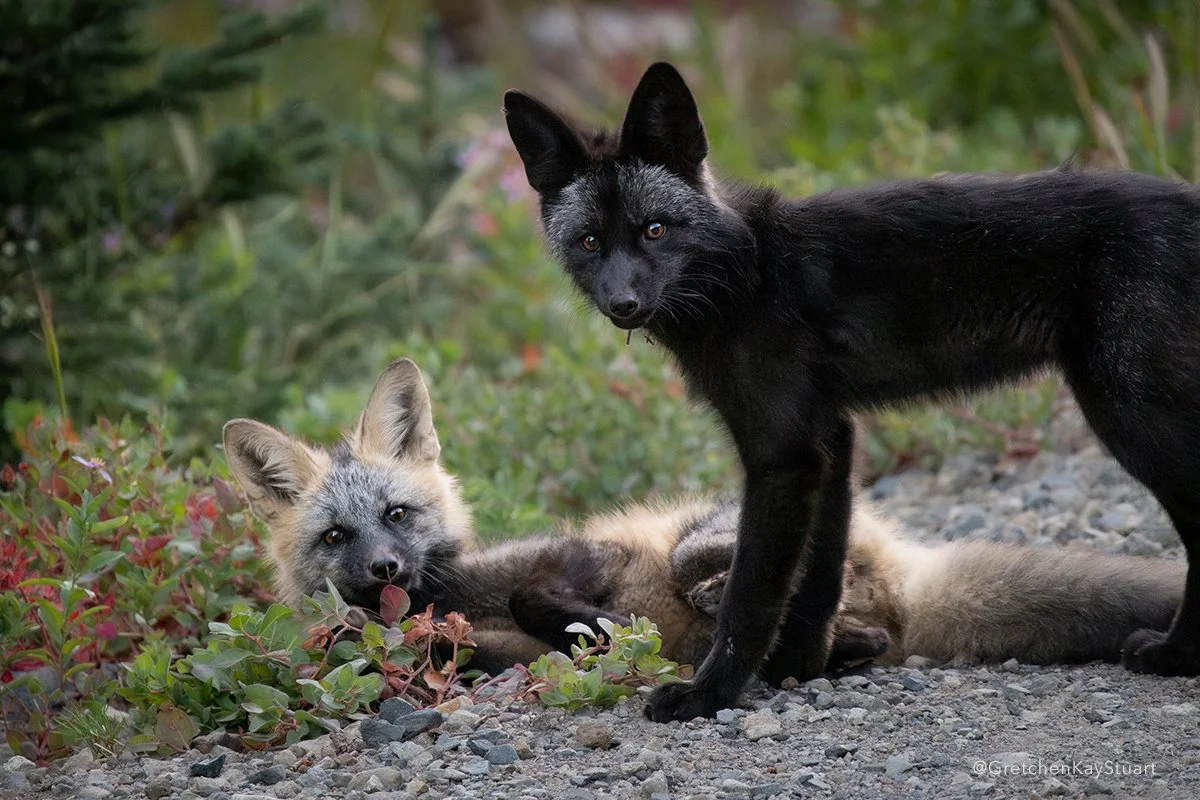
Cascade red fox kits by Gretchen Kay Stuart

The male cross-phase kit and his sister, 2B.

To ensure my presence did not disrupt their natural behavior, my observations were made from a blind at a distance using a long lens. This allowed me to witness the fox family’s authentic world without obvious disturbance.

This is just the beginning of the story. Stay tuned for more den discoveries in upcoming posts!

Tags Cascade red fox, Fox Kits, Mount Rainier National Park

POWERED BY SQUARESPACE